I remember my first three-mile hike with my dog. I grabbed a cheap leash and water, assuming I’d handle any issues as they arose.
Twenty minutes in, the leash clasp snapped when my dog lunged at a squirrel. I had no water but muddy puddles, and had to carry every waste bag in my pockets, feeling like a terrible game-show contestant.
That experience taught me a key lesson: your dog’s gear can make the difference between frustration and enjoyment. The equipment you choose affects every outing, whether in a small apartment or on weekend adventures.
Understanding What Makes Dog Gear Actually Practical
Through many hikes and walks, I’ve learned practical gear solves the real problems you face and won’t fail when challenged. It’s not about buying the most or the cheapest gear, but about finding what actually works.
Functional dog gear starts with strong materials. I once thought all nylon was the same until I watched a cheap leash fray after two months.
Quality nylon webbing, the kind that’s tightly woven and treated for weather resistance, feels completely different in your hands.
It has weight to it, the edges don’t fray easily, and it maintains its integrity even after getting soaked and dried repeatedly.
Metal hardware is non-negotiable for me now. Those plastic clips might look sleek and modern, but I’ve had too many break at really inconvenient times.
A solid metal clasp might add a few ounces to your gear, but it’s worth every bit of that extra weight when you’re dealing with an excited 60-pound dog who just spotted another dog across the trail.
The difference becomes obvious the first time you see a plastic clip snap under pressure while a metal clasp holds firm.
What separates truly practical gear from flashy accessories is how well it addresses real-world problems. Urban dog owners face completely different challenges than those living in suburban houses with yards.
If you’re in an apartment, storage space is genuinely valuable; you can’t dedicate an entire closet to dog equipment.
Collapsible bowls, multi-function tools, and gear that packs down small become essential rather than just nice-to-have features.
Getting the Fit Right
Getting the fit right matters more than people expect. I once bought an expensive harness online without measuring, thinking ‘medium’ would work.
It wasn’t.
The chest strap sat too far back, creating pressure points that made my dog uncomfortable, and the whole thing shifted around during walks instead of staying in position.
Proper measurement takes about 5 minutes and prevents returns or equipment issues. To fit a harness, measure neck circumference at the widest point, chest circumference right behind the front legs, and length from the base of the neck to the base of the tail.
These measurements decide which harness styles will work best for your dog’s body type.
The two-finger rule is based on how pressure is distributed across your dog’s body. When a collar or harness is properly fitted, you should be able to slide two fingers between the gear and your dog’s skin comfortably.
Tighter than that, and you’re restricting blood flow and potentially causing discomfort.
Looser than that, and the gear can slip off or shift out of position when you need control most.
Different activities require different fit considerations. A harness for casual neighborhood walks can be slightly looser because you’re not dealing with challenging terrain or sudden directional changes.
Hiking harnesses need to fit snugly. Uneven ground and natural obstacles cause your dog to move unpredictably. Loose gear can catch on branches or shift during climbs, creating hazards.
Building Your Core Gear System
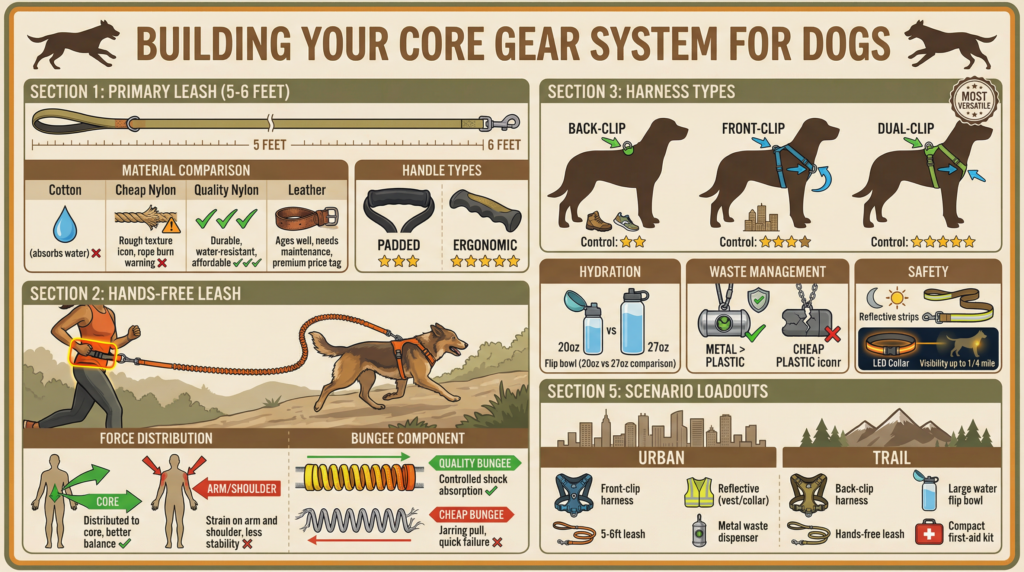
Starting fresh with dog gear can be overwhelming. I recommend building your collection strategically: begin with daily essentials and add specialized gear for your activities.
Your Primary Leash
You’ll handle your everyday leash most often, so invest in quality. For general use, a 5- to 6-foot leash strikes the right balance between control and freedom.
This length prevents your dog from wandering too far while still allowing them enough space to sniff, explore, and do their business without feeling constantly restrained.
Material choice matters. I’ve used cotton rope, cheap nylon, quality nylon, and leather; each has unique traits.
Cotton looks nice, but soaks up water and dries slowly, which is a problem if you walk in the morning when the grass is dewy.
Budget nylon often feels harsh and can cause rope burn if your dog pulls suddenly. Quality nylon webbing with slight texture and tight weave strikes the best balance for most situations.
It’s durable, water-resistant, comfortable to hold, and affordable.
Leather deserves special mention for its unique properties. A quality leather leash improves with age as it softens and molds to your grip.
It’s naturally strong, looks professional, and doesn’t absorb water the way cotton does.
The downside is cost and maintenance; leather needs conditioning to prevent drying and cracking.
Handle design matters more than you’d think. I used to ignore this until a long walk left my palm raw from a poorly designed handle.
Padded handles with soft neoprene or fleece wrapping distribute pressure more evenly across your hand. This makes longer walks genuinely more comfortable.
Some handles are ergonomically shaped to fit your hand’s natural curve. This reduces fatigue during extended outings.
Hands-Free Leashes for Active Adventures
Once you hike or jog with your dog, hands-free leashes are transformative. I resisted trying one, thinking waist attachment would feel odd.
The first time I used one on a trail run, though, I immediately understood what I’d been missing.
Hands-free leashes typically wrap around your waist with an adjustable belt, then connect to your dog via a bungee-style cord that absorbs shock from sudden movements. This setup distributes pulling force across your core rather than concentrating it in your arm and shoulder, making it much easier to handle a strong dog during active pursuits.
The bungee component is crucial; it acts as a shock absorber when your dog changes direction or speed. Without that elastic element, every pull would jerk your whole body. This makes the experience unpleasant for both of you. Quality bungee cords stretch smoothly and return to their original length. Cheap versions lose their elasticity quickly and start feeling saggy after a few uses.
Choosing the Right Harness
Harnesses solve problems that collars can’t. This is especially true for dogs who pull or for activities that require more control. The attachment point location dramatically changes how the harness works. Understanding these differences helps you choose the right style.
Back-clip harnesses attach at the top of your dog’s back, between the shoulder blades. This design lets your dog move its shoulders naturally. It’s ideal for hiking, running, and any activity requiring a full range of motion.
The downside is that back-clip harnesses offer less control over pulling. When your dog pulls, the attachment moves in the same direction, which keeps the behavior going.
Front-clip harnesses attach at the chest. The mechanics work completely differently. When a dog pulls forward while wearing a front-clip harness, the tension causes them to turn slightly toward you instead of continuing straight ahead.
This gentle redirection discourages pulling without causing discomfort. Front-clip harnesses are excellent for training and urban walking, where precise control is needed.
I’ve found that dual-attachment harnesses offer the most versatility. These designs include both a back clip and a front clip, allowing you to switch between configurations as needed.
I use the front clip when walking through crowded city streets, where I need control. Then I switch to the back clip when we hit the trails, so my dog has full freedom of movement.
The material and construction quality of harnesses vary widely. The best have multiple adjustment points to customize the fit across your dog’s body.
Cheaper versions might adjust only in one or two places. This means you’re stuck with whatever fit comes closest to your dog’s proportions, instead of being able to dial in the perfect fit.
Padding makes a significant difference in comfort, especially for dogs who wear harnesses for extended periods. Quality padding stays soft even after getting wet and dried multiple times, while cheaper foam padding tends to compress and lose its cushioning properties relatively quickly.
Essential Accessories That Solve Real Problems
Beyond leashes and harnesses, several accessories address specific pain points that active dog owners consistently encounter. I’ve learned to assess these items based on how effectively they solve actual problems rather than how clever or innovative they seem.
Hydration Solutions
Keeping your dog hydrated during outdoor activities used to mean carrying a separate bowl and water bottle, which was bulky and inefficient. The integrated water bottle and bowl designs changed this completely for me.
These bottles include an attached bowl that flips out from the top or side, allowing you to pour water directly into the drinking surface without needing a separate container.
The best designs include a locking mechanism that prevents accidental spills when the bottle is bouncing around in your pack. I’ve used versions without this feature, and inevitably, I’d reach for water only to find the bottle had leaked all over everything else in my bag.
A simple twist-lock or flip-lock mechanism prevents this frustration entirely.
Capacity matters based on your activity duration and your dog’s size. A 20-ounce bottle works fine for short walks or hikes with small to medium dogs, but for larger dogs or longer outings, a larger capacity is needed.
I carry a 27-ounce bottle for serious hikes, which provides enough water for my dog without adding excessive weight.
Collapsible bowls offer another space-saving solution, particularly useful if you prefer carrying water in a standard bottle. These bowls fold flat or collapse to a minimal thickness, making them easy to fit in a pocket or a small pack compartment.
Silicone versions are more durable than fabric, maintaining their shape better and cleaning more easily after use.
Waste Management
Nobody enjoys talking about poop bags, but having a reliable waste management system makes every walk more pleasant. I used to just stuff bags in my pocket, which worked until I forgot about them and ended up with an unpleasant surprise later.
Dedicated bag dispensers that attach to your leash handle or belt loop keep bags accessible without taking up pocket space.
The dispenser design matters; cheap plastic versions crack and break relatively quickly, especially in cold weather when the plastic becomes brittle. Metal or high-quality polymer dispensers last significantly longer and function more reliably.
Some include a small carabiner or clip for easy attachment to various gear, while others use a loop system that slides over your leash handle.
Bag quality varies more than you’d expect. Ultra-thin bags save material and cost less, but they’re also more likely to tear at the worst possible moment.
Slightly thicker bags cost a bit more but provide much better reliability and reduce the stress of wondering whether the bag will hold up during use.
Visibility and Safety Gear
Reflective elements and high-visibility colors are legitimate safety features that can prevent accidents. I walk early in the morning when it’s still dark, and the difference between reflective gear and non-reflective gear is striking.
Drivers, cyclists, and other pedestrians can see a dog wearing reflective equipment from much greater distances, giving everyone more time to react and avoid potential conflicts.
LED collars and clip-on lights take visibility even further. These battery-powered lights make your dog visible from hundreds of feet away, even in complete darkness.
Some designs offer multiple modes, steady light, slow flash, and rapid flash, allowing you to choose the pattern that provides the best visibility for your specific situation.
Reflective leashes and harnesses work by bouncing light back toward their source, making them particularly effective when illuminated by headlights or flashlights. The reflective material is often woven directly into the webbing or applied as trim along the edges, providing 360-degree visibility rather than reflecting only from one angle.
Adapting Your Setup for Different Scenarios
The gear configuration that works perfectly for urban walking might need adjustment for other activities. I’ve developed different loadouts for different situations, keeping the core items consistent while swapping specialized equipment based on my plans.
Urban Walking
City walks prioritize control, visibility, and the management of encounters with other dogs and people. I use a front-clip harness for steering ability, especially when navigating crowded sidewalks or crossing busy streets.
A standard 5-6 foot leash provides the right balance, long enough that my dog doesn’t feel constantly restrained, short enough that I can maintain close control when needed.
Visibility matters more in urban environments than people often realize. Cars, bicycles, and pedestrians all pose potential conflicts, and being clearly seen reduces risks.
I use gear with reflective elements even during the day because parked cars pulling out or cyclists approaching from behind need to see us clearly to avoid problems.
Trail and Hiking
Hiking setup shifts toward freedom of movement and hands-free operation. I switch to a back-clip harness that allows full shoulder range of motion, essential for scrambling over rocks or navigating uneven terrain. The hands-free leash attaches around my waist, keeping my hands free for balance and allowing me to use trekking poles if needed.
Hydration becomes critical on longer hikes. I carry a larger-capacity water bottle with an attached bowl, planning for roughly 1 ounce of water per pound of dog weight per hour of activity in moderate temperatures.
Hot weather significantly increases requirements, sometimes doubling the amount needed.
Emergency gear matters more when you’re farther from immediate help. I include a basic first-aid kit with items specifically for dogs, gauze for wrapping injured paws, tweezers for removing thorns or ticks, and a small LED flashlight in case we’re on the trail longer than expected.
Frequently Asked Questions
What length leash is best for walking a large dog?
A 5-6-foot leash provides the best balance for large dogs during regular walks. This length gives you enough control to manage your dog in various situations while still allowing them reasonable freedom to move and explore.
Longer leashes make it harder to maintain control in unexpected situations, while shorter leashes can feel too restrictive for both you and your dog.
Do dogs really need harnesses, or are collars enough?
Harnesses distribute pressure across your dog’s chest and shoulders instead of concentrating force on their neck, the way collars do. For dogs who pull, have respiratory issues, or join in active pursuits like hiking, harnesses provide better control and reduce the risk of injury.
Collars work fine for well-trained dogs who walk calmly on leash, but harnesses offer advantages in most situations.
How do I keep my dog hydrated on long hikes?
Carry a dedicated dog water bottle with an attached bowl, planning for about one ounce of water per pound of body weight per hour of moderate activity. A 50-pound dog needs about 50 ounces for a one-hour hike in moderate temperatures.
Double this amount in hot weather.
Take water breaks every 15-20 minutes during strenuous activity.
What features should I look for in a hands-free leash?
A quality hands-free leash needs a comfortable, adjustable waist belt that evenly distributes weight, a bungee section that absorbs shock from sudden movements, and durable metal hardware at all connection points. The bungee component should stretch smoothly and return to its original length consistently.
Look for designs that allow quick release in emergency situations.
Are reflective collars necessary for daytime walks?
Reflective elements provide safety benefits even during daylight hours. Parked cars pulling into traffic, cyclists approaching from behind, and runners or other walkers all benefit from seeing you and your dog clearly.
While reflective gear becomes essential during low-light conditions, having it on daytime walks adds an extra layer of safety that costs nothing once you’ve invested in the equipment.
How much weight can a dog safely carry in a backpack?
Dogs should never carry more than 25% of their body weight, which means a 60-pound dog maxes out at 15 pounds of gear. Start with much less weight initially, perhaps 10% of body weight, and gradually increase as your dog builds strength and becomes accustomed to wearing the pack.
Always distribute weight evenly between both sides of the pack.
Do dog boots actually stay on during hikes?
Quality dog boots with proper closure systems stay on reliably during hikes. Look for boots that use multiple closure methods, typically a combination of elastic, velcro, and sometimes drawstrings.
The fit needs to be snug without restricting circulation.
Dogs need time to acclimate to wearing boots, so practice with short sessions before attempting serious trail use.
What’s the difference between front-clip and back-clip harnesses?
Front-clip harnesses attach at the chest and redirect pulling dogs toward you, naturally discouraging pulling behavior. Back-clip harnesses attach between the shoulder blades, allowing full shoulder motion but providing less control over pulling.
Front-clip works better for training and urban walking, while back-clip suits hiking and running, where natural movement matters more than steering control.
Key Takeaways
Start with foundation pieces, quality leash, properly fitted harness, and reliable water solution, before adding specialized equipment.
Measure your dog accurately and understand their specific body type to confirm proper fit across all gear categories.
Prioritize durability and function over aesthetics, choosing materials like quality nylon webbing and metal hardware that withstand intensive use.
Build separate configurations for different activities instead of trying to create a single setup that works equally well for everything.
Test new equipment in low-stakes situations before relying on it for challenging adventures where gear failure creates genuine problems.
Invest in visibility features such as reflective elements and LED lights to enhance safety in low-light conditions.
Remember the 25% weight limit for dog backpacks and pack strategically to maintain balance and comfort.
Leave a Reply