
Article-At-A-Glance
- Understanding why your dog barks is the crucial first step to effectively addressing excessive barking behavior
- The “quiet” command, coupled with consistent positive reinforcement, can significantly reduce problem barking within weeks.
- Environmental management techniques such as visual barriers and sound masking can immediately reduce barking triggers.
- Dogs with sufficient physical exercise and mental stimulation are naturally less likely to develop nuisance barking habits.
- Professional training assistance can provide specialized solutions for persistent barking problems that don’t respond to basic techniques.
Persistent dog barking can turn your peaceful home into a stress zone and strain relationships with neighbors. The good news is that with the right approach, even the most vocal dogs can learn to be quieter. By understanding why your dog barks and using targeted training techniques, you’ll be on your way to a more peaceful household.
Understanding the Reasons Behind Dog Barking and Identifying Problematic Barking
Barking is a dog’s way of communicating, much like how humans use speech. Dogs bark to warn of potential threats, to show enthusiasm, to get attention, or to react to other dogs. However, this normal behavior can become an issue if it’s excessive, inappropriate, or happens at the wrong times.
Understanding why your dog barks is key to effectively addressing the behavior. There are different types of barks for different situations, and each needs a unique training method. A bark to alert you is not the same as a bark out of boredom, and a bark from anxiety has its own unique rhythm.
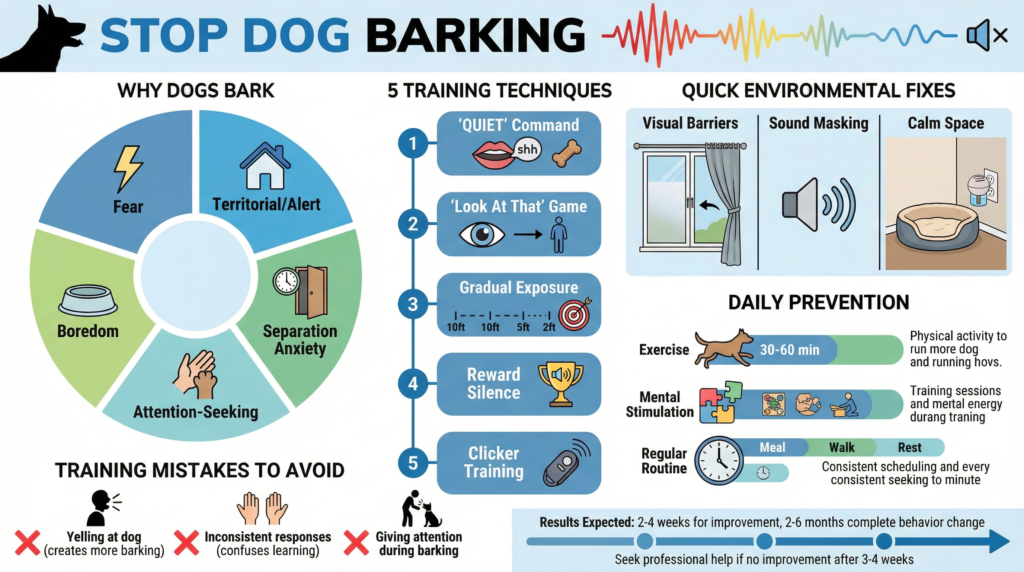
Excessive barking is usually caused by territorial reactions, separation anxiety, desire for attention, boredom, or fear. Once you know what’s causing your dog to bark, you can adjust your training strategy to be as effective as possible.
Typical Reasons Dogs Bark and How to Address Them
When a dog is protecting its territory or is alert: Prevent the dog from seeing what triggers the barking.
If a dog is seeking attention: Don’t reward the barking, but give praise when the dog is quiet.
If a dog has separation anxiety: Slowly get the dog used to being alone.
If a dog is bored: Provide more physical and mental activity
If a dog is afraid: Replace the fear with something positive.
5 Top Training Techniques to Curb Excessive Barking

Training is the best long-term solution for barking issues, as it creates permanent behavior changes rather than short-term fixes. The techniques below work across all breeds and barking types, but consistency with your chosen method is most important.
1. Train Your Dog to Understand the “Quiet” Command
Training your dog to understand the “quiet” command is an effective way to stop unnecessary barking. Allow your dog to bark a few times, then say “quiet” in a firm, yet calm voice while holding a treat near their nose. When they stop barking to smell the treat, praise them and reward them with it. Over time, they’ll learn to associate the command with stopping barking.
Practice this command daily, and in increasingly complex scenarios. Begin in a calm setting with few distractions, then slowly progress to using it during real barking triggers. Always reward successful quiet moments generously, especially in the early training stages.
2. Divert Their Attention with the “Look at That” Game
This game is designed to retrain your dog’s emotional response to stimuli that typically trigger barking. Instead of barking, it encourages them to look at you. Say “look at that” when your dog spots something that would normally cause them to bark before they start. Call their name straight away to redirect their attention to you. Give them a treat and praise them when they look at you.
The “Look at That” method is effective for dogs that bark at the door, at windows, or during walks. With time, your dog will learn to look to you for cues when they see something that usually makes them bark, instead of barking right away.
3. Gradually Expose Your Dog to the Things That Cause Them to Bark
By gradually exposing your dog to triggers that cause barking, you can help them get used to them and avoid barking. For example, if your dog tends to bark when they see visitors, start by having a friend stand far from your house, give your dog a treat when they don’t bark, and gradually move the friend closer over several training sessions.
Changing your dog’s emotional reaction to triggers can be a game-changer. Keep sessions short (5-10 minutes) and always end on a high note. Desensitization works best when paired with counter-conditioning, making the trigger a positive experience through treats and praise.
4. Reward Your Dog When They’re Silent
Dogs are more likely to repeat behaviors that earn them rewards. When your dog is quiet in a situation where they would normally bark, reward them immediately with treats, praise, or play. This “capturing” method helps your dog learn that being quiet leads to good things.
With this method, reward timing is crucial. Reward your dog for quiet behavior, not after they’ve started barking again. Be diligent about rewarding quiet behavior in situations that have previously triggered barking. Over time, your dog will opt for quiet behavior more often.
5. Using Clicker Training to Control Barking
Clicker training offers precise timing to mark the exact moment your dog is quiet, which is the behavior you want. The click noise is an immediate marker that tells your dog, “Good job, that’s exactly what I wanted.” Start by linking the clicker with treats, then click and give a reward when your dog is quiet after something that usually makes them bark or when they stop barking when you tell them to.
Clicker training is a powerful tool because it is clear and consistent. It enables dogs to quickly grasp which behavior has earned them a reward, making their learning process more efficient. For barking issues, the clicker is great for identifying brief moments of silence that might otherwise be overlooked or not rewarded.
How to Stop Various Kinds of Problematic Barking
Depending on what’s causing your dog to bark, you might need to adjust your approach for the best outcome. While the basic principles of training stay the same, minor tweaks to your method can have a big impact on its success.
Preventing Alert Barking at Entrances and Windows
Alert barking is triggered when your dog notices potential dangers or interesting happenings outside. This protective behavior is beneficial to a certain extent, but can be troublesome when it becomes excessive. Begin by controlling the environment: shut the blinds or apply window film to prevent your dog from seeing high-traffic areas. Set up a cozy watching post away from windows where your dog can unwind instead of being on the lookout.
If your dog reacts to the doorbell, try desensitizing them by playing doorbell sounds at a low volume and rewarding them for staying calm. You can gradually increase the volume over several sessions. Teach them a different behavior, like going to a mat when the doorbell rings, and reward them generously for this calmer response. If you practice consistently, your dog will learn that they don’t need to bark frantically when someone arrives.
How to Handle Barking for Attention
Barking for attention can be annoying because any response to it, even a negative one, reinforces the behavior. The main idea is to ignore the barking while generously rewarding quiet behavior. This means not speaking, touching, or making eye contact when your dog barks for attention.
As soon as your dog stops barking, even if it’s just for a moment, give it attention and maybe a treat. Consistency is key. If family members sometimes respond to attention barking, your dog will learn to bark longer and more persistently. To see results faster, teach and reward an alternative way to ask for attention, such as bringing a toy to you or sitting quietly beside you.
Address Barking Due to Separation Anxiety
When your dog is barking because of anxiety, you need to use a holistic approach that addresses the root cause of the emotional distress. Start with slow-departure training: go through the motions of leaving (e.g., grabbing your keys, putting on your shoes) without actually going anywhere, until your dog is calm during these actions that used to trigger them. Keep your departures and arrivals low-key to avoid making these transitions a bigger deal than they need to be.
If the situation is difficult, consider asking your vet about temporary anti-anxiety medication to help with the training process. Make alone time a positive experience by offering special treats or toys only when you’re about to leave. Many dogs find the background noise from a TV or radio soothing, as it can drown out outside noises and break up the anxiety-inducing silence.
Stop Barking Caused by Boredom
Dogs that don’t get enough mental and physical exercise often bark because they’re bored or frustrated. High-energy dogs need a way to burn off that energy. Make sure your dog gets more exercise every day by taking longer walks, playing more, or doing activities that fit your dog’s abilities and breed.
Keep your dog’s toys interesting by rotating them regularly, and give them puzzle toys that require them to work for a treat. Training sessions also help keep your dog engaged and prevent boredom-related barking. If you’re away during the day, consider hiring a dog walker or taking your dog to daycare a few times a week. It will give them a break from being alone all day.
Effective Strategies for Managing Your Dog’s Environment
Training can help identify why your dog is barking, but managing their environment can provide quick relief by limiting the triggers. These strategies help your dog succeed by creating an environment that makes it easier for them to stay quiet.
Eliminating Visual Stimuli
Many dogs bark at things they can see through windows or fences. You can use removable window film on lower windows to let light in while blocking the view of people walking by, mail carriers, or other dogs. For sliding glass doors, consider decorative static cling films that cover the bottom while leaving the top clear for visibility.
Using Sound to Distract
Playing background noise can distract your dog from outside sounds that may cause barking. Whether it’s a white noise machine, classical music, or Music for Dogs tracks, these sounds create a barrier that helps reduce alertness to external noise. Constant background noise can also help mask sudden environmental changes that may startle your dog and cause barking.
Many dog owners have found that their pets respond well to TV programs featuring nature scenes or other dogs, providing both auditory and visual stimulation. If you live in an apartment or townhouse and share walls with neighbors, you can reduce noise transmission by using sound-absorbing panels or placing bookshelves strategically against the shared walls.
Acoustic conditioning can also help your dog become less sensitive to certain sounds that trigger barking. Some apps play sounds like doorbells, delivery trucks, and other common triggers at controllable volumes, which can help your dog get used to them.
- Adjustable white noise machines
- Music compilations specifically for dogs that promote relaxation
- Apps that desensitize dogs to sound by gradually increasing exposure
- Acoustic panels for walls that are near busy areas
- Weather stripping for doors to limit the amount of sound that gets through
When using sound masking, prioritize consistency over loudness. Moderate, steady background noise is more effective than loud music, which can cause sensory overload or stress.
Creating a Serene Space
- Create a peaceful sanctuary where your dog can escape from overwhelming stimuli.
- Use pheromone diffusers, such as Adaptil, to create a chemically soothing environment.
- Keep a comfortable temperature and good ventilation to prevent physical discomfort.
- Reduce chaotic household activity during initial training phases.
- Consider light-blocking curtains for dogs that are triggered by shadows or light patterns.
The physical environment affects your dog’s stress levels and barking threshold. Set up a relaxation area with your dog’s bed or crate in a quiet area away from windows and doors. This space should always be positive and never used for punishment.
By providing your dog with suitable chew toys, lick mats, and food puzzles, you can provide a healthy outlet for energy that might otherwise be expressed through barking. To maintain your dog’s interest and the effectiveness of these items, rotate them regularly.
If you have more than one dog, keep them in separate areas during training sessions. This can help prevent one dog’s barking from setting off the others. Once each dog has made some progress, you can gradually let them be together again. Just make sure to keep rewarding them for staying quiet.
Everyday Routines to Lessen Barking
Establishing a daily routine that reduces your dog’s tendency to bark excessively is an effective strategy. Dogs whose physical and mental needs are met are less likely to develop problematic barking behaviors. Incorporating these routines lays the groundwork for success with any training regimen.
Keep in mind that it’s always simpler to prevent a problem than it is to correct it, especially when it comes to your dog’s behavior. By establishing these routines early, you can prevent barking problems before they start, particularly with younger dogs.
How Much Exercise Different Dog Breeds Need
Each dog breed has different exercise needs based on what it was originally bred to do. For example, herding breeds such as Border Collies and Australian Shepherds require substantial physical and mental exercise daily to prevent frustration and excessive barking. Terriers, bred to hunt and kill vermin, need an outlet for their instincts to dig and chase. Guardian breeds, on the other hand, benefit from structured opportunities to patrol their territory in ways that satisfy their territorial instincts without causing problems.
Ensure your exercise approach is tailored to your dog’s needs rather than using a one-size-fits-all solution. High-energy breeds may require 30-60 minutes of vigorous exercise twice daily, while some companion breeds may be content with shorter, less intense activity. The quality of exercise is as important as the quantity; activities that engage your dog’s natural instincts provide mental stimulation alongside physical exertion.
Think about engaging your dog in activities such as fetch, swimming, agility, nose work, or herding trials that suit your dog’s breed-specific energy level. A dog that gets plenty of exercise will naturally be calmer and less likely to react to things that usually make it bark during the day.
Activities to Stimulate Your Dog’s Mind
Mental stimulation can be as effective as physical exercise, and a dog that’s mentally satisfied is less likely to bark out of boredom or frustration. Add food puzzles, snuffle mats, and treat-dispensing toys to your dog’s routine. These provide enrichment even when you can’t play with your dog. They require your dog to use problem-solving skills, which engages their brain and provides a good outlet for natural foraging instincts.
Teaching your dog new skills or tricks can provide a great mental workout for them and strengthen your bond. Just a few minutes of focused training several times a day can greatly reduce barking by providing your dog with mental stimulation and positive interaction. Scent work can be particularly effective for many dogs – hiding treats around your home or teaching your dog formal scent detection games can engage their most powerful sense and provide them with a deep sense of satisfaction.
- Switch up puzzle toys often to keep them new and challenging.
- Train your dog with new commands or tricks for 5-10 minutes multiple times a day.
- Make your own scent games by hiding treats around your house.
- Create obstacle courses with things you have around the house.
- Teach your dog the names of objects to help them build cognitive skills and vocabulary.
Setting a Regular Routine
Dogs do well with predictability, and a regular daily routine can help lessen anxiety that might cause barking. Set regular times for meals, walks, play, and rest that your dog can look forward to. This predictability gives them a sense of security and can help reduce stress-related barking. If you have to change the routine, try to keep as much of the normal schedule as possible to minimize disruption.
Teach your dog to relax quietly by incorporating scheduled relaxation times into your everyday routine. You can use these times to practice “place” or “settle” commands, rewarding your dog for staying quiet and calm on a mat or bed. Eventually, your dog will learn to stay quiet and calm during these designated relaxation times. This skill can also be applied to other situations where you want your dog to stay quiet and calm.
Items That Can Aid in Minimizing Barking
Training is the cornerstone of addressing barking issues, but a few measures can help foster a quiet environment. These items are most effective when used with regular training, not as a one-off solution.
Engaging Toys and Food Puzzles
Turn mealtime into a game with food puzzles or slow feeders. This can help reduce boredom-induced barking. Instead of eating out of a bowl, let your dog earn their meal by figuring out puzzles that slowly release food. This mental stimulation fulfills their cognitive needs and naturally creates periods of concentrated silence.
If your dog is alone during the day, keep them entertained and reduce barking by giving them interactive toys. Try freezing Kongs or other toys you can stuff with food; they’ll keep your dog entertained longer. Getting the food out of the toy takes concentration, which can help stop your dog from barking.
Our Top Picks for Interactive Toys Based on the Reason for Barking.
When They Miss You: A Kong filled with something delicious and frozen.
If They’re Bored: A puzzle feeder that makes them think.
When They’re On Guard: A lick mat placed far from windows.
If They Want Your Attention: A toy they can play with by themselves that moves in unexpected ways.
Relaxation Supplements and Tools
If your dog barks due to stress or hyperactivity, calming aids may help reduce their anxiety. Thundershirts apply mild, consistent pressure that soothes many dogs, much like swaddling. This pressure therapy can be especially beneficial during high-stress events that often trigger barking, such as thunderstorms or fireworks.
Herbal remedies that contain L-theanine, chamomile, or CBD (where it’s legal) might help to lessen anxiety-induced barking in some dogs. Always consult your vet before starting any supplement regimen to ensure it’s suitable for your dog’s unique health needs. These aids are most effective when used as part of a holistic approach that includes behavior modification, rather than as standalone solutions.
Using Sound Machines and White Noise to Quiet Your Dog
Sound machines that emit constant, soothing noise can help mask external triggers that cause your dog to bark. The consistent noise acts as a buffer against sudden noises, such as a car door slamming or a delivery truck arriving, which could otherwise startle your dog into barking. Some dogs respond well to certain sound frequencies designed to promote relaxation, such as classical music or specially composed dog music that uses tempos and tones proven to reduce stress.
Typical Training Errors to Steer Clear Of
Even caring dog owners can make mistakes that inadvertently encourage barking or undermine the effectiveness of training. Knowing these common mistakes can increase your chances of success with bark training.
Consistency and timing are key in training your dog. If you give mixed signals or respond at the wrong time, you can confuse your dog and make your training less effective.
How Screaming at Your Dog Can Make the Barking Worse
Yelling at a barking dog might seem like it would help, but it usually just makes things worse. To your dog, it might seem like you’re barking along with them, which can make them bark even more. Plus, your yelling might make your dog more anxious or excited, which can make it harder for them to calm down and stop barking.
Dogs are sensitive to our emotions. They sense when we’re upset or angry, which can make them feel the same way. This can lead to a cycle where the more they bark, the more frustrated we get, and the more they bark. Instead of raising your voice, stay calm and confident. This will help your dog stay calm too. Give commands in a firm but quiet voice, and instead of punishing them when they bark, reward them when they’re quiet.
The Issue with Unpredictable Reactions
Dogs flourish on reliable cause-and-effect connections, and unpredictable reactions to barking cause confusion that hinders learning. If you sometimes overlook barking, sometimes reprimand, and other times give attention, your dog never learns a clear rule about what behavior achieves their goal. This unpredictability often results in more persistent barking as your dog tries different lengths and intensities to elicit a response.
When to Seek Help from a Professional Dog Trainer
If you have tried basic training techniques for 3-4 weeks and you’re not seeing improvement, or if the barking is significantly impacting your daily life, it might be time to seek help from a professional. Certified dog trainers or behaviorists can spot subtle things you might have overlooked and create a personalized plan for your situation. They are especially helpful for complex cases involving fear-based barking, aggression, or severe separation anxiety that may require specialized protocols.
Common Questions

As a dog owner, you may have specific questions about barking that aren’t fully covered by general training advice. These answers to frequently asked questions provide additional guidance for unique situations you may encounter during your training.
What is the average time it takes to train a dog to stop barking?
Most dogs show improvement within 2-4 weeks of consistent training, but it can take 2-6 months for barking to completely stop, depending on how ingrained the habit is. Newer habits are easier to break than older ones. Consistency as a trainer is more important than breed or intelligence; applying the same response to every instance of barking can speed up the training process. Don’t be discouraged by temporary setbacks, as barking often increases before it decreases when using extinction-based techniques.
Should you ever use anti-bark collars?
Many professional dog trainers and veterinary behaviorists recommend avoiding shock, citronella, and ultrasonic anti-bark collars. They argue that these devices only treat the symptoms, not the root causes, and can lead to fear or anxiety in your dog. While they may temporarily stop the barking, they often lead to increased stress or to redirected problem behaviors. On the other hand, positive reinforcement methods are more likely to have lasting effects without the risk of psychological side effects. If you’re thinking about getting a collar because you’re at your wits’ end, it’s probably a sign that you need professional help with your dog’s behavior, rather than a quick fix.
Is it possible to train an older dog to stop barking excessively?
Whether they are physically comfortable (pain can cause more barking)
How well their brain is functioning (senior cognitive dysfunction can affect their ability to learn)
Whether they can hear well (this can affect how they respond to spoken commands)
How long have they had the habit of barking
Whether the training approach is consistent
Contrary to the saying you can’t teach an old dog new tricks, older dogs can be taught to bark less. It may take more patience and consistency than with a younger dog, but it’s possible. Older dogs that have been barking excessively for a long time may need more repetition before the new behavior becomes automatic. Still, in many cases, their calmer temperaments can make the training process easier.
When dealing with older dogs, it’s crucial first to rule out any medical causes of their increased barking. Pain or cognitive dysfunction can cause them to bark more. Training sessions should be kept short and frequent to account for their potentially reduced stamina, and more desirable rewards should be used to keep them motivated. For more tips, you can explore ways to stop dog barking.
Keep in mind that your dog might have sensory problems: a dog with hearing loss might not be able to hear your verbal cues, but can still learn visual signals effectively. With the right approach, dogs of any age can learn to bark less.
Can fixing my dog help with the barking?
Getting your dog fixed might help with some types of barking, especially those driven by hormones, such as territorial or frustration barking. But it really depends on the dog, and you’ll see the biggest difference in males who haven’t been fixed and whose behavior is driven by hormones. Fixing your dog won’t be a direct solution for most barking problems, especially if your dog barks because they’re anxious, bored, or have learned to bark to get attention.
Before deciding on spaying or neutering as a solution for barking, talk to your vet about what you can realistically expect. These procedures can provide numerous health and behavioral advantages, but they should not be viewed as a standalone solution for barking.
Do certain dog breeds bark more than others?
Yes, some breeds are more likely to bark more often or in certain situations due to their genetic makeup. For example, hounds like Beagles and Basset Hounds were bred to bark while tracking, so they tend to be more vocal. Small terriers often start barking at a lower threshold, while guardian breeds like the Great Pyrenees were bred to bark to scare off potential threats.
Knowing the typical behaviors of your dog’s breed can help you know what to expect and how to handle them. For instance, a Basenji (often called the “barkless dog”) may hardly ever make noise, while a Finnish Spitz (often called the “King of Barkers”) may need more focused training. But, breed tendencies are just that – tendencies. Your dog’s individual personality and what they’ve learned in the past are just as important in figuring out why they bark.
Even though you may not be able to stop all barking in a breed that is naturally prone to being vocal, you can channel and moderate the behavior with consistent training. Instead of trying to stop all barking in breeds that are naturally more vocal, teach them when it is appropriate to bark.
For breeds that are naturally inclined to bark, it’s especially important to manage this behaviour. Meeting the specific needs of these breeds often reduces excessive barking more effectively than simply trying to train the dog not to bark.
Leave a Reply